

1. Start with the object
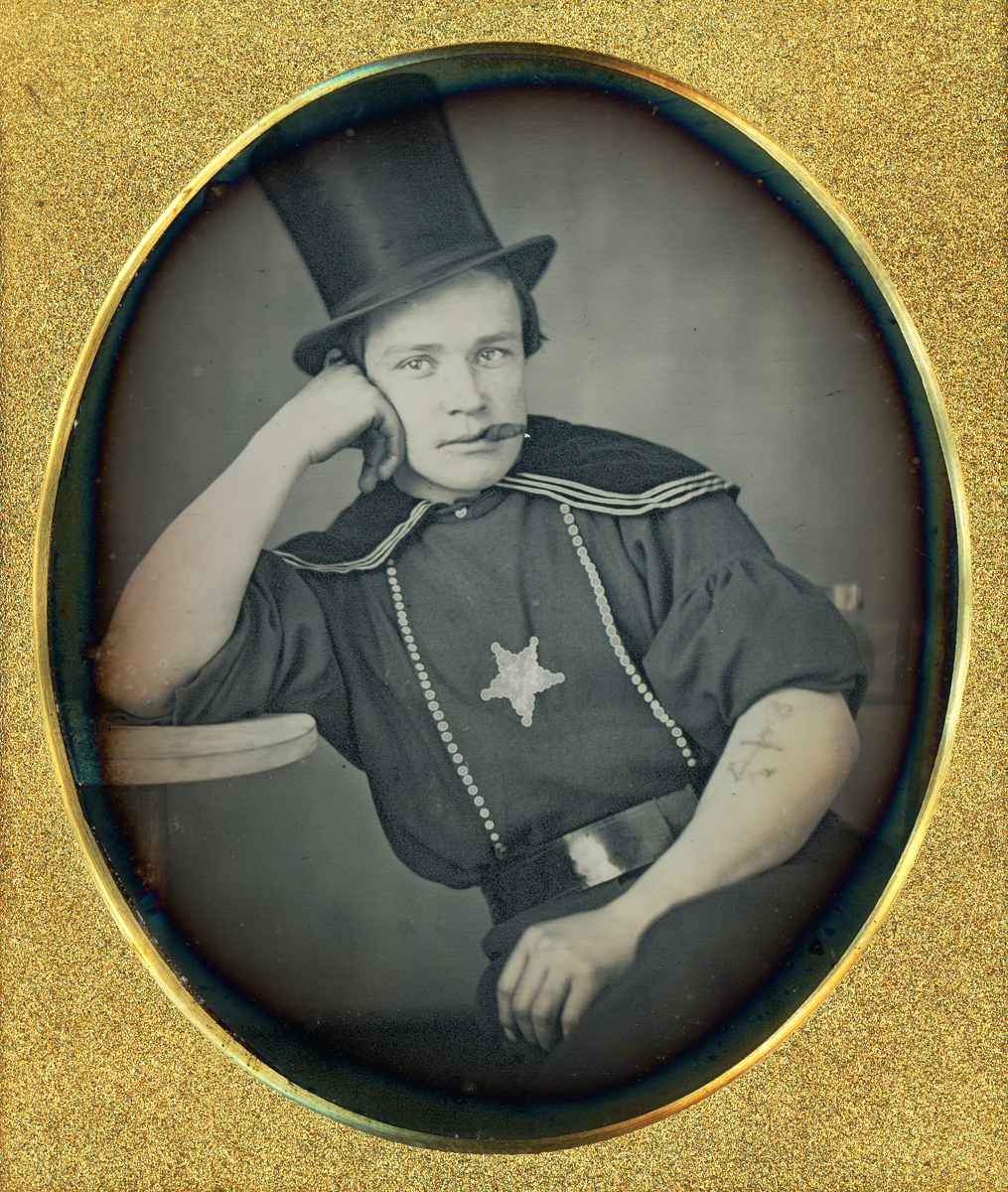
The photograph shows a young man in a dark sailor-style garment with a striped collar, a tall hat, a star-shaped ornament at his chest, and a broad belt. He sits informally, one hand supporting his head. On the exposed forearm at the right of the image, the principal mark reads clearly as an anchor surmounted by a heart; smaller marks sit beside and below it.
Their placement and appearance are consistent with tattooing. The anchor-and-heart design is legible in the unenhanced plate, although the smaller adjacent marks cannot yet be identified confidently. Nothing has been drawn over, sharpened, or reconstructed here. A firm process and date also require examination of the plate, mat, preserver, case, and reverse—not only the digital image.
2. A name in print
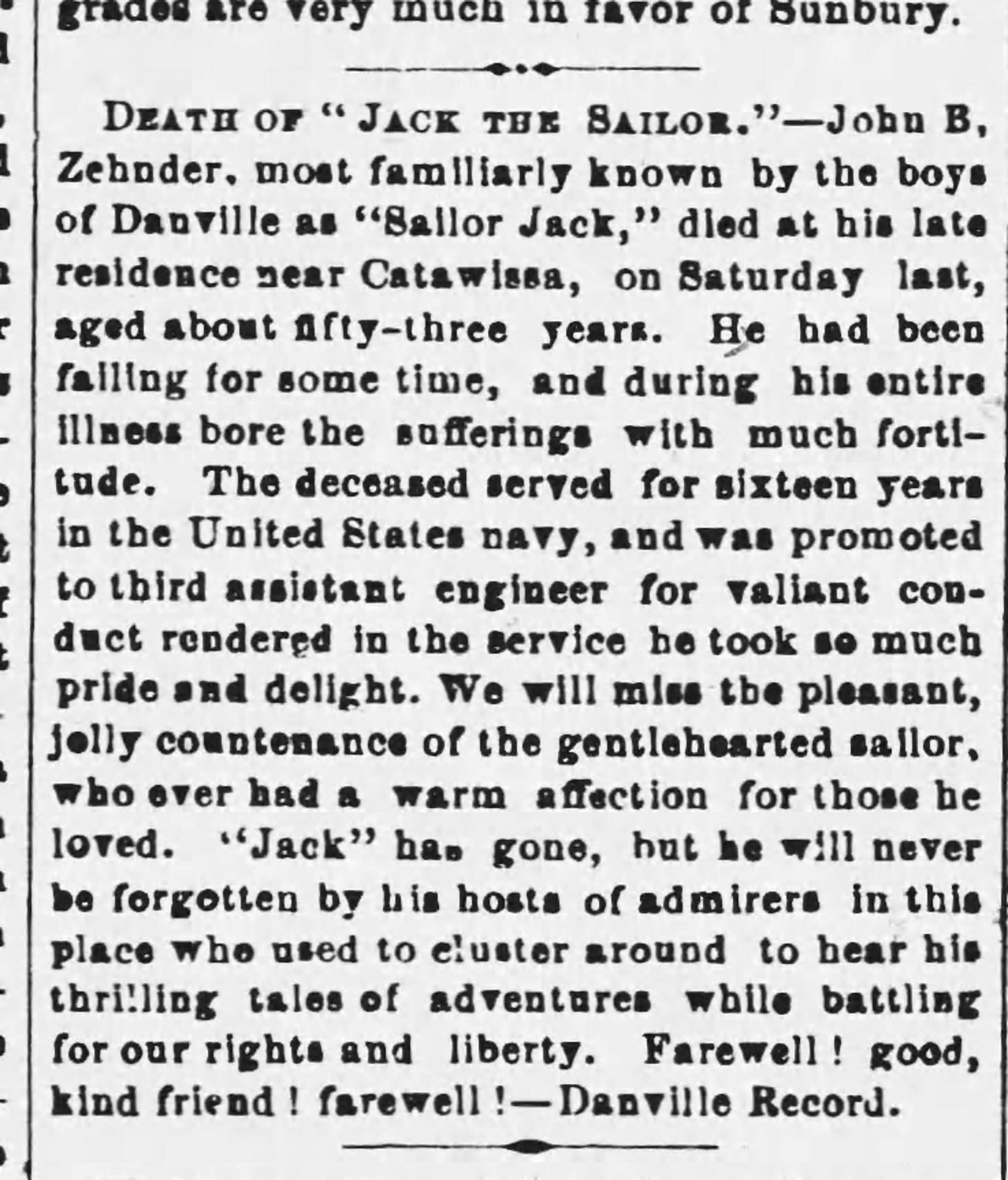
The accompanying clipping identifies the sitter as John B. Zehnder, “most familiarly known by the boys of Danville as ‘Sailor Jack.’” It says he died at his residence near Catawissa at about fifty-three years old after a period of illness.
It further reports sixteen years in the United States Navy and says he was promoted to third assistant engineer for “valiant conduct.” Third assistant engineer was a real nineteenth-century naval rank. That makes the wording plausible, but plausibility is not confirmation: no service register, death record, or independently digitized copy of the original newspaper has yet been matched to this clipping.
3. Transcription of the obituary
“Death of ‘Jack the Sailor.’—John B. Zehnder, most familiarly known by the boys of Danville as ‘Sailor Jack,’ died at his late residence near Catawissa, on Saturday last, aged about fifty-three years. He had been failing for some time, and during his entire illness bore his sufferings with much fortitude. The deceased served for sixteen years in the United States navy, and was promoted to third assistant engineer for valiant conduct rendered in the service he took so much pride and delight. We will miss the pleasant, jolly countenance of the gentlehearted sailor, who ever had a warm affection for those he loved. ‘Jack’ has gone, but he will never be forgotten by his hosts of admirers in this place who used to cluster around to hear his thrilling tales of adventures while battling for our rights and liberty. Farewell! good, kind friend! farewell!—Danville Record.”
This is a diplomatic reading from the supplied image, with line breaks removed and punctuation retained where legible. The item appears to reprint or credit the Danville Record; the title of the newspaper in which this particular clipping appeared is unknown.
4. What can be said about the marks
The sitter's exposed forearm carries a plainly readable anchor surmounted by a heart, with smaller marks nearby. Its placement and appearance are compatible with a hand-poked sailor tattoo, a practice documented among American seafarers well before photography. Written protection papers from 1796–1818 record anchors, initials, crucifixes, hearts, and other tattoo marks used to identify sailors.
The smaller forms are not fully legible, and their meaning should not be invented. But the principal device does not require that level of caution: it is visibly an anchor-and-heart tattoo on a sitter identified by the clipping as a long-serving sailor.
5. What the mark tells us
An anchor beneath a heart is not a random pairing. In nineteenth-century devotional and decorative language the cross, the anchor, and the heart formed a recognised triad standing for faith, hope, and charity—the theological virtues of 1 Corinthians 13:13. The anchor carried hope because Hebrews 6:19 describes hope as “an anchor for the soul, firm and secure,” and the heart carried love. What sits on this young man's forearm is two of those three.
The triad was not confined to jewellery and printed bibles. It entered tattoo flash and design books from port cities, and it survives in official descriptions of sailors' bodies. When the Royal Navy arrested John Teede in 1799 on suspicion of the Hermione mutiny, it recorded the tattoos covering his arms so he could be identified beyond doubt; the list runs from religious devices to the people he loved. Large collections of nineteenth-century British and American records log anchors, hearts, ships, and initials on the same arms with real regularity. The device on this plate belongs to that documented vocabulary, not to a private invention.
Three conclusions follow, and they are worth stating plainly. First, the marks corroborate the clipping from an entirely independent direction: a conventional mariner's emblem sits on the arm of a man a newspaper identifies as a sixteen-year naval servant. Second, the marks are almost certainly deliberate tattooing rather than damage to the plate, because they resolve into a known composition—scratches, dust, and chemical blemishes do not arrange themselves into period flash. Third, the technique implied is the older one: hand-poked with needles and simple pigments during downtime at sea, the practice colonial and early national sources describe as being “mark'd with gunpowder,” well before professional shops opened in American cities in the 1870s and before the electric tattoo machine of the 1890s.
What the emblem records, in its own idiom, is an attachment. Hearts in this vocabulary generally name or honour someone—a sweetheart, a wife, a mother, sometimes someone already dead—while the anchor holds that person fast. That is why the small marks beside the anchor matter so much: in comparable records they are most often initials. Read on the object itself, they may name the person he chose to carry to sea.
The convention also opens a documentary door. Tattooed marks were official identification data. American seamen's protection certificates from 1796 onward described their holders, merchant seamen's registers recorded “marks on person,” and naval and civil descriptions routinely listed tattoos. A desertion notice, shipping article, protection certificate, or pension file that describes Zehnder's arm in words would tie the name, the sailor, and this plate together far more tightly than any stylistic argument can.
What the emblem cannot do is date the plate or speak for its owner. The reading above is a documented convention, not proof of what Zehnder personally intended, and the motif persisted for the better part of a century—so it narrows the field without pinning a decade.
6. Is it the earliest known photograph of a tattoo?
Not on the evidence presently assembled. There is no single universally accepted “first photograph of a tattoo,” and the question changes depending on whether one means any tattooed person, an American, a Western sailor, or a photograph in which the tattoo itself is plainly visible.
The strongest documented early comparison comes from Japan. Photographs of tattooed Japanese men are attested from 1859, with further portraits associated with Felice Beato and other photographers in the early 1860s. Those examples mean this portrait should not be called the world's earliest known tattoo photograph without an earlier secure date and a comprehensive corpus comparison.
Its importance remains substantial. If examination confirms an early plate process and the identification is tied securely to Zehnder's life and service, it may be an unusually early named American sailor portrait in which tattoos are visible—a more precise and potentially more meaningful claim.
7. A headstone record
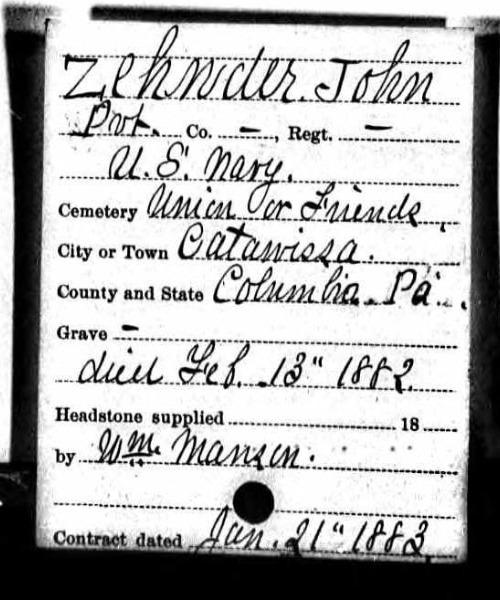
The federal card index of government headstones for Union veterans holds a handwritten card reading “Zehnder John — Pvt. — Co. –, Regt. – — U.S. Navy”, buried in the “Union or Friends” cemetery at Catawissa, Columbia County, Pennsylvania, died February 13, 1882. The stone was supplied by a local cutter (the name reads approximately “Wm. Mansen”) under a contract dated January 21, 1883. Name, naval service, and Catawissa—the town the obituary ties to Sailor Jack—line up.
Seeing the original card resolves the earlier puzzle. “Pvt.” is simply the card’s rank line, filled in by habit; the company and regiment lines are left blank and the service is written plainly as U.S. Navy. The 17th Missouri Infantry entry that appeared beside it in a web transcription belongs to a different John Zehnder, on the neighbouring card, buried near Dayton, Ohio.
8. Service records
Two further index entries for a John B. Zehnder suggest the outline of a career:
- 1861 roster: Samuel P. Bates’s official History of Pennsylvania Volunteers, 1861–5 (vol. 1) lists “Zehnder, John B.,” private, Company A, Eighth Regiment—a three-month regiment of April 1861 whose Company A was recruited at Shamokin, Northumberland County, one county over from Catawissa. Read the roster (Internet Archive).
- Civil War enlistment: Private, enlisted and mustered at Harrisburg, Pennsylvania, January 2, 1864, age 34 (born about 1830), cavalry, 1st Provisional Pennsylvania Mounted.
- Naval hospital record: age 51 (born about 1828), admitted July 16, 1879, discharged July 12 (year not shown in the index), with ships listed as USS Monongahela, USS Warren, and USS Lexington.
The birth years agree with each other and with the obituary’s age of about fifty-three at an 1882 death. The naval entry is the first document to put a John B. Zehnder aboard named U.S. Navy vessels, which directly supports the obituary’s long naval service—though as an enlisted man, not necessarily an officer, consistent with his absence from the Navy officer lists. These are index summaries seen secondhand; the original hospital ticket and enlistment papers should be checked before the chain is treated as proven.
9. What the ships tell us
The three ship names are more revealing than they first look, because two of them belong to the age of sail and were out of service long before 1879.
- USS Warren, a sailing sloop-of-war of 1827, joined the Pacific Squadron in 1843 and stayed on the west coast for the rest of her career—through the Mexican War and the California Gold Rush—until she was decommissioned in 1859 and sold at Panama in 1863. No other Navy vessel bore the name before 1879.
- USS Lexington is either the sailing sloop of 1826—a storeship from 1840, on the Pacific coast during the Mexican War, with Perry’s expedition to Japan in 1853–55, decommissioned 1855—or the Civil War river timberclad of 1861–65. Both were gone before 1866.
- USS Monongahela, a steam sloop commissioned in 1863, served at Mobile Bay and remained in commission into the 1870s, making her the likely last ship of a long career.
If the index is right that one John B. Zehnder served on all three, his naval service began no later than 1859 and plausibly in the 1840s or 1850s—on the Pacific station, where sailors were tattooed and where daguerreotypists followed the Gold Rush. That would make a pre-Civil War portrait of a young tattooed sailor entirely consistent with the documents, and it gives the obituary’s “sixteen years” room to be literal. It does not date this plate; it widens the window in which the plate can honestly be placed.
It also sharpens the search. Enlisted men’s records for the Warren and Lexington survive in Navy muster and pay rolls (National Archives, Record Group 24), and period rolls often describe each man’s height, complexion, and marks. A roll describing an anchor and heart on John Zehnder’s arm would join the photograph to the paper man.
10. What remains open
- Newspaper: locate the original issue, date, and page behind the clipping and its credit to the Danville Record.
- Naval record: pull the full hospital ticket and the muster rolls of the Monongahela, Warren, and Lexington; test the sixteen-year and promotion claims, and look for a physical description listing his marks.
- Marks described in words: search protection certificates, shipping articles, desertion notices, and prison or almanac descriptions for a written account of his arm—contemporary records listed tattoos as identification.
- Life record: confirm the headstone application (National Archives, Record Group 92) and the 1864 enlistment papers, then establish family and the “Union or Friends” burial through cemetery, probate, and census sources around Danville and Catawissa.
- Object date: examine the plate, case, mat, preserver, and any hallmark or inscription in person.
- Tattoo comparison: compare the object with securely dated holdings in photographic and tattoo-history collections.
This page will change when new evidence appears. Corrections and primary records are welcome; the aim is not to defend a superlative, but to build the strongest account the object can bear.
11. What would settle it
Five documents, ranked by how much each would change the case. None is online in full; each has a known home.
- The muster roll with a description. Navy muster and pay rolls (National Archives, Record Group 24, Washington, D.C.) and, for enlistments after 1865, the weekly returns of enlistments at naval rendezvous routinely recorded height, complexion, and “marks.” A line reading anchor and heart on the right forearm would tie the man, the name, and the photograph together in one contemporary hand. Request by ship and approximate year through NARA's Archives I reference staff or a hired Washington researcher.
- The 1879 hospital ticket. Medical journals and hospital tickets of naval hospitals (Record Group 52, Bureau of Medicine and Surgery) often repeat the enlistment description and give birthplace and service history in his own account.
- The headstone application file. The card we reproduce is an index to a contract; the supporting application (Record Group 92, Quartermaster General) can name the applicant—usually family or a veterans' post—and confirm which John Zehnder lies at Catawissa.
- The obituary on microfilm. The National Record (Danville), issues of February 18 and 25, 1882, held on microfilm at the State Library of Pennsylvania and through the Montour County Historical Society. The original page fixes the text, date, and source of the clipping.
- The object itself, in hand. Plate hallmark, mat style, preserver, and case design date the photograph independently of every paper record—and decide whether it belongs to the daguerreian decade or later.
If the first document exists and says what the photograph shows, the question stops being whether this is Sailor Jack and becomes how early the plate is. That is the case worth making.
12. Institutional leads
Two museums hold the country's deepest collections on the tattooed American sailor, and neither shows a Zehnder in its online catalog. That absence means little: both hold large uncatalogued and partially digitized holdings, and both employ staff who have spent careers on exactly this subject. These are the doors to knock on.
- The Mariners' Museum and Park, Newport News, Virginia. Holds the Thomas Moore Tattoo Image Collection and the August “Cap” Coleman collection of tattoo flash, needles, and ephemera—acquired in 1936, the earliest documented institutional acquisition of American tattoo material. Its photography archives include identified Civil War–era sailor portraits. A query to its collections staff asking whether any early photograph in the tattoo collections shows an anchor-and-heart forearm, or is identified as a Pennsylvania sailor, costs an email.
- Mystic Seaport Museum, Mystic, Connecticut. Holds the largest maritime photography collection in the world, including portraits of mariners across the nineteenth century, and hosted Skin & Bones: Tattoos in the Life of the American Sailor. Its research library accepts remote reference queries.
- Independence Seaport Museum, Philadelphia. The Skin & Bones exhibition originated here, researched by curator Craig Bruns—the scholar who has looked hardest at tattoos in American sailor life. If anyone has already compiled a census of early tattoo photographs, or knows of a rival claimant to “earliest,” it is likely him.
The question to put to each is narrow and answerable: does your collection hold any photograph of a tattooed sailor dated before 1860, and do you know of one elsewhere? A negative answer from all three strengthens the case for this plate more than any document we could pull ourselves.
Sources & further reading
- The supplied newspaper clipping, headed “Death of ‘Jack the Sailor,’” crediting the Danville Record. Newspaper, date, and page not yet identified.
- “Card Records of Headstones Provided for Union Civil War Veterans, 1879–1903,” transcription at Genealogy Trails, entry “Zehnder, John — US Navy — Union or Friends, Catawissa, Columbia Co., PA — d. Feb. 13, 1882.” The cards derive from National Archives Record Group 92. Read the transcription.
- Ira Dye, “The Tattoos of Early American Seafarers, 1796–1818,” Proceedings of the American Philosophical Society 133, no. 4 (1989): 520–554. Evidence for tattooing among American sailors before photography.
- Library of Congress, “Daguerreotypes,” overview of the process introduced in 1839 and its use in the United States. Library of Congress collection guide · archived copy.
- Museum of Fine Arts, Boston, collection records and scholarship on Felice Beato's photography in Japan, alongside the broader early Japanese photographic record. Search the MFA collection.
- Horimono Shashin: Tattooing and Photography in Japan 1850–1900, a study of the early Japanese tattoo-photography record, including examples attested from 1859. Publication record.
- The Met, Heilbrunn Timeline of Art History, “The History of the Daguerreotype,” for process history and dating context. Read at The Met · archived copy.
- Colonial Williamsburg, “Tattoos in Early America,” on eighteenth- and early nineteenth-century tattooing practice, materials, and vocabulary. Read at Colonial Williamsburg · archived copy.
- “‘Mark’d with Gunpowder’: Tattoos in Early America,” Lives & Legacies, on the period phrase for tattooing and its appearance in contemporaneous newspaper descriptions. Read at Lives & Legacies.
- Navette Jewellery, “Symbolism in antique jewellery – faith, hope and charity (love),” on the cross–anchor–heart triad, the anchor as hope in Hebrews 6:19, and its early Christian use. Read at Navette Jewellery.
- Tattoo Archive, “Faith, Hope and Charity,” on the same triad as it appears in European and American tattoo flash. Read at Tattoo Archive.
- Lucas Radford, “The Tattoos of a Mutineer, 1799,” The Navy Records Society: the official tattoo description of John Teede and what such records reveal. Read at The Navy Records Society.
- Naval History and Heritage Command, “Sailors' Tattoos: A Basic Primer,” on United States naval tattoo tradition and its functions. Read at NHHC · archived copy.
- Zoe Alker and Robert Shoemaker, “Convicts and the Cultural Significance of Tattooing in Nineteenth-Century Britain,” Journal of British Studies 61 (2022): 835–862, open access, drawing on tens of thousands of written tattoo descriptions in which anchors and hearts recur. Read the PDF · publisher page.
- Nicholas Schonberger, “Inking Identity: Tattoo Design and the Emergence of an American Industry, 1875 to 1930,” MA thesis, University of Delaware, 2005, on when hand-poked folk tattooing gave way to a commercial industry. Read the PDF · repository page.
- The Mariners' Museum and Park, online catalog, including the Thomas Moore Tattoo Image Collection and the Cap Coleman collection (acquired 1936). Search the catalog · “The art of the tattoo”.
- Mystic Seaport Museum, Collections & Research, photography collection overview. Read at Mystic Seaport.
- “The Ink of History,” Commonplace: The Journal of Early American Life, reviewing Skin & Bones: Tattoos in the Life of the American Sailor (Independence Seaport Museum, curator Craig Bruns), including George S. Geer's 1862 account of tattooed shipmates aboard USS Monitor. Read at Commonplace.
Research note: open-web searching did not independently confirm Zehnder's biography or establish this portrait's date. The Japanese comparison is a documented reason to avoid the unqualified “earliest known” claim; it is not presented as a complete census of all surviving tattoo photographs.