

A stereoview is two photographs of the same scene, taken a few inches apart and mounted side by side on a card. Look at it through a stereoscope and each eye sees only its own picture. Your brain puts the two together and the scene opens up in depth. From the 1850s into the 1930s these cards were sold by the millions. Most parlors had a viewer and a box of cards.
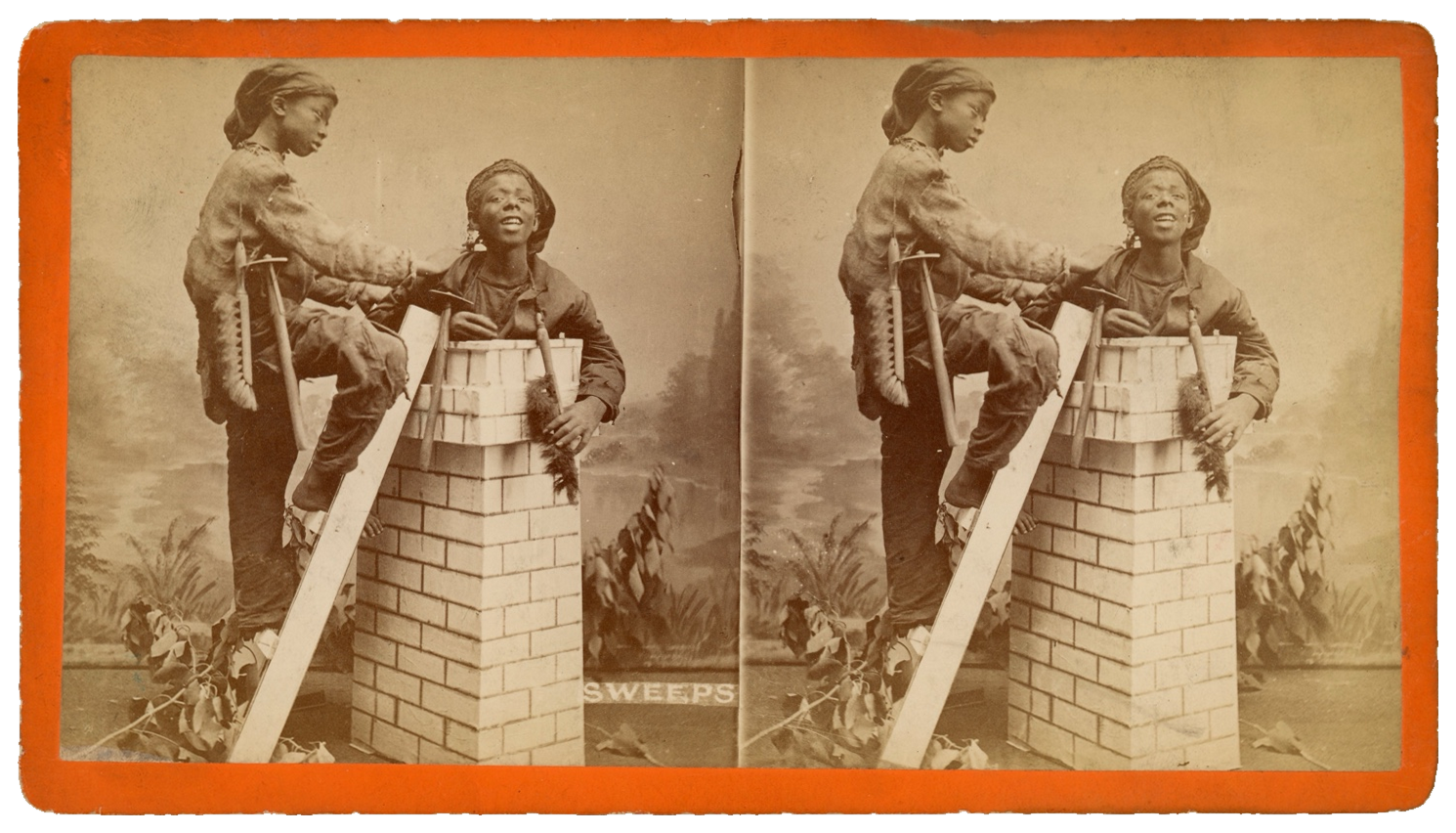
Quick check
- Choose one close object and one distant object. Their spacing should change between the two views.
- Look for a sliver of scene that appears at one outside edge but not the other.
- If every detail sits in exactly the same place, it is a monoview (identical duplicate), not a stereo pair.
Why two pictures
Your eyes sit about two and a half inches apart, so each one sees the world from a slightly different spot. Close objects shift a lot between the two views. Far objects barely shift at all. The brain reads that difference as depth.
A stereo camera does the same thing with two lenses set about an eye-width apart. The two prints look the same at a glance. Lay one over the other, though, and the foreground slides against the background. That sliding is the whole trick.
Not every stereoview is stereo
A card having two pictures on it doesn't make it a true pair. Collectors run into three kinds:
- Real pair. Two views from two lenses, or from one camera moved sideways between exposures with nothing in the scene changing. The foreground shifts against the background, and the card has real depth in a viewer.
- Monoview (identical duplicate). The same negative printed twice. Publishers did this when they only had one image, or wanted a single photograph to fill a stereo line. Both eyes get the same picture, so it looks flat in any viewer.
- Camera moved. Two exposures made one after the other, where the camera tipped or the subject moved in between. Parts of the scene line up and parts don't: a person in a different pose, a horizon at a different height. In a viewer these fight your eyes instead of opening into depth.
How to check a card by eye
- Pick a close object and a far one. A post and a distant roofline work well. Measure the gap between them on the left print, then on the right. On a real pair the gap changes. On a duplicate it stays the same.
- Look at the edges. Each print usually shows a little more on one side than the other. Where the extra is depends on what was close to the lens.
- Look for movement. Heads, horses, water, and trees in wind give away an exposure made at a different moment.
- Use a viewer. Any stereoscope settles it in a second. So can free-viewing, if you can relax your eyes until the two prints drift into one.
How we check ours
Every stereoview in the shop goes through the same test. Software lines up the left and right prints, then measures how far each small patch of the picture has shifted. A real pair shows different shifts for near and far. A duplicate shows none. A moved-camera card shows patches that don't match at all, or that have slid up and down as well as sideways. Every result gets a look from a person, and the person's call is the one that counts.
We only show depth effects on cards that are real pairs. We never fake a second view from a single photograph.
The full method — every step, threshold, and formula — is written up in How the stereo analysis works.
What the analysis measures
Each scan gets compared at a fixed working size. The software picks out textured patches of the picture, finds where each one landed in the other print, and reports three numbers:
- Match. The share of patches that correspond reliably between the two prints. High means the two pictures really are the same scene. Low means the camera moved, the subject moved, or the prints don't belong together.
- Depth spread. How much the sideways shift varies from patch to patch. Near objects shift more than far ones, so a real pair has spread. Two pixels or more at working size is enough to call it genuine stereo. Zero spread means the two prints are the same picture.
- Vertical. Up-and-down shift between the prints. Stereo depth is a sideways thing, so vertical shift is trouble: a tipped camera, a crooked scan, or two prints trimmed differently. Four pixels or more and the alignment can't be trusted.
Those three numbers sort every card into one of four calls:
- Genuine stereo pair. Good match, real depth spread, little vertical shift. The card will open up in a viewer.
- Monoview (identical duplicate). No depth spread and the two prints are more than ninety percent alike overall. One negative printed twice.
- Camera moved. Match falls below half, or vertical shift runs high. Something changed between the two exposures.
- Inconclusive. Too few usable patches, or numbers that land between the lines. These get set aside for a closer look by eye.
How much to trust the numbers
The genuine-pair and duplicate calls are the solid ones. Depth either varies between the prints or it doesn't, and that's hard to fake and hard to misread. The moved-camera call is softer, because a crooked scan or a heavy crop can look like camera movement. That's why every card also gets a human review, and why any call can be overridden when the evidence says otherwise.
The confidence score you see on a listing is a formula score based on how far the numbers clear their thresholds, capped so it never reads as certainty. It is not a laboratory probability. Treat it as "how clearly did this card pass," not "how sure are we." The measurements themselves are relative to a fixed working size, so they compare card to card, not inches on the original.
Dating by the mount
The card itself is the fastest clue. These are rough ranges with plenty of overlap:
- Square corners, thin flat card, often white or cream: late 1850s to about 1868.
- Rounded corners on flat card: from about 1868 onward.
- Bright mounts in yellow, orange, pink, green, or lavender: popular in the 1870s.
- Heavier curved mounts, bent to help the viewer: from about 1880.
- Gray or black curved mounts from big publishers: 1890s to the 1930s. Underwood & Underwood and Keystone are the common names.
Also check the back. A photographer's printed name, address, and view list can be traced in city directories. A tax stamp on the back dates a card to 1864 to 1866.
Care
Store stereoviews upright in a box built for them, snug enough that they don't lean. Curved mounts should stay curved, so don't press them flat. The rest of the care guide applies too.
Sources & further reading
- Library of Congress, Stereograph Cards.
- Charles Wheatstone, “Contributions to the Physiology of Vision,” Philosophical Transactions of the Royal Society of London 128 (1838): 371–394.
- William C. Darrah, The World of Stereographs (Gettysburg, PA: Darrah, 1977).
The thresholds and confidence formulas used by Macrafly are documented separately in the technical paper below. They are catalogue rules developed for this collection, not standards taken from these historical sources.