1. The object in hand
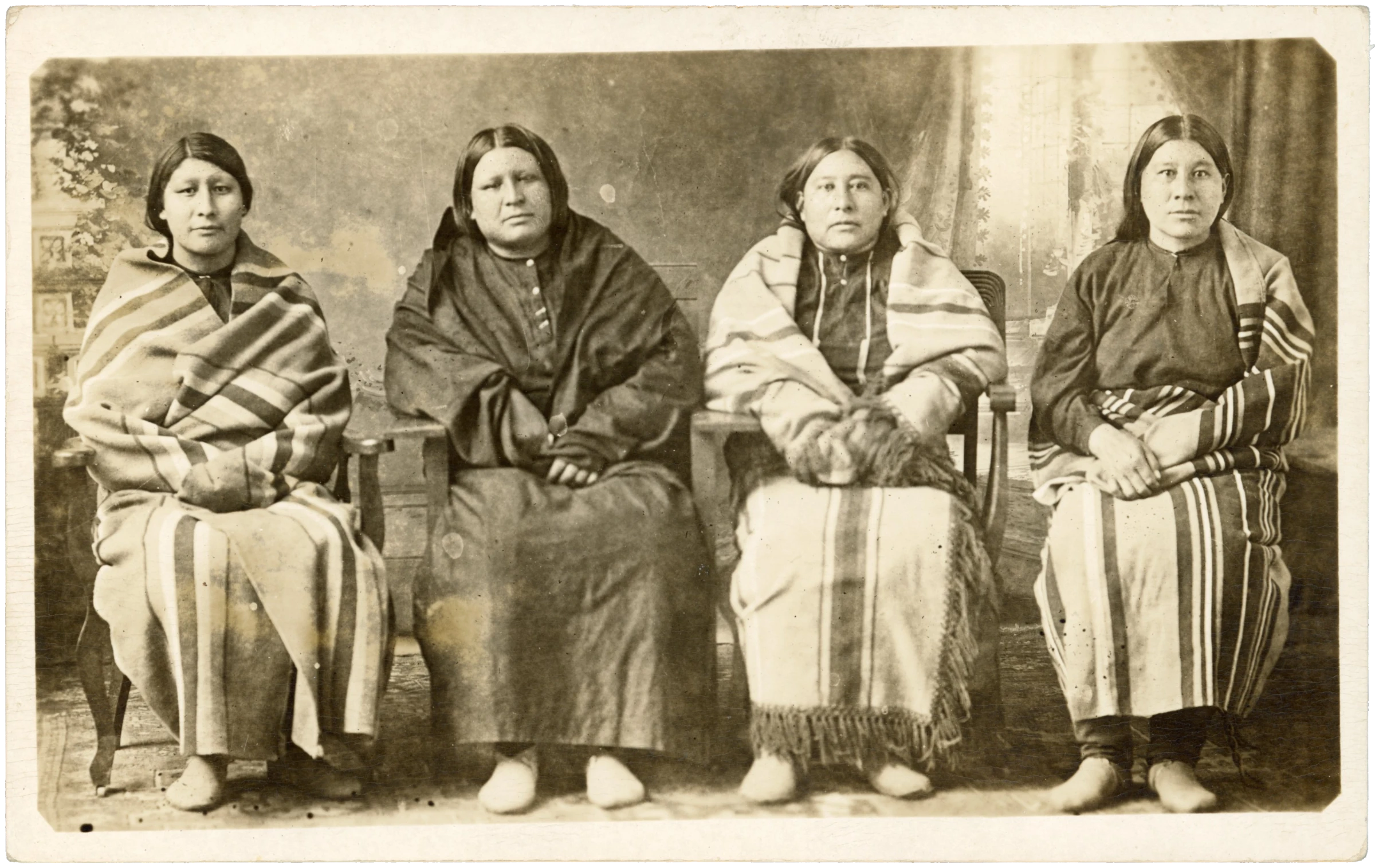
The front is a photographic image on postcard stock, not a later halftone reproduction. Four women sit shoulder to shoulder against a painted studio background. Blankets, clothing, chairs, backdrop, floor, and every pose align with the independently published image. This is not merely the same subject: it is the same exposure.
The complete photograph matters. Some widely circulated accounts reproduce another photograph of three sisters. That image should not be used as visual corroboration for this four-woman portrait. Here, identification rests on exact matches to the four-sitter composition.
2. Following the photograph outside this card
Cowboys & Indians publishes the matching photograph with the left-to-right caption “Rita Smith (Me-se-moie) 284, Anna Brown (Wah-hrah-lum-pah) 258, Mollie Burkhart Cobb 285, probably Minnie Smith 283.” Its companion feature credits the image to the Osage Nation Museum and the Raymond Red Corn collection.
Cynthia Coleman Emery reproduces the same four-woman image, captions the sitters from left as Rita, Anna, Mollie, and Minnie, and credits “The Osage National Museum/Doubleday,” with the date missing. This is a useful independent publication of the image, but it is a secondary caption rather than a museum catalogue record.
The two public captions agree on the order. They differ in certainty at the far right: one says Minnie; the more detailed caption says probably Minnie. This article follows the more cautious form. A stable public museum accession record for this exact photograph has not yet been located.
3. The reverse is evidence—but not an identification
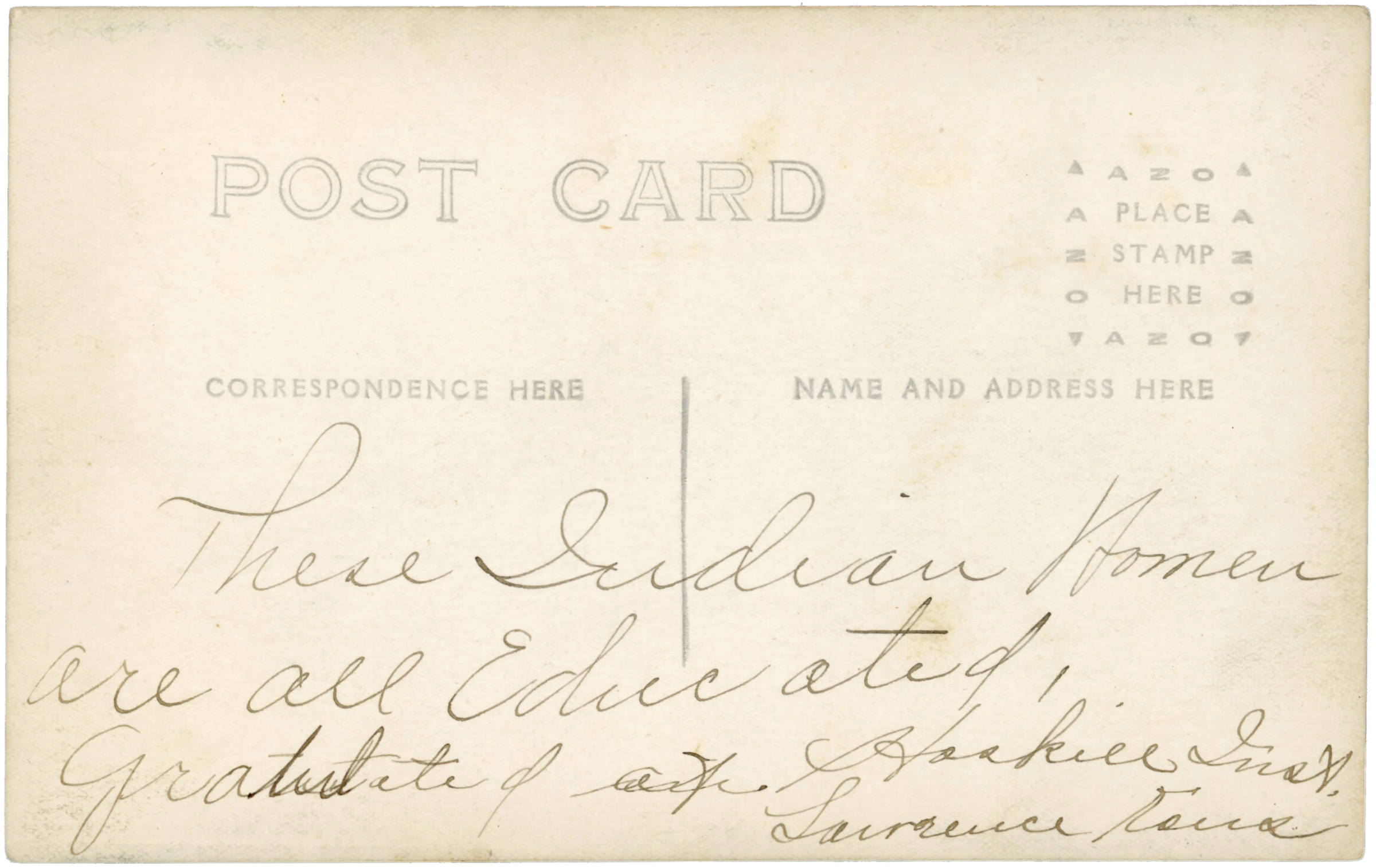
The inscription reads:
“These Indian Women are all Educated, Graduated at Haskell Inst. Lawrence Kans.”
The writer supplies no names. The inscription therefore did not identify the sitters; the independent image match did. “Carlisle” is not written on this card. The visible wording names Haskell Institute in Lawrence, Kansas.
No school record found during this review establishes that the four Kyle sisters graduated from Haskell. The Carlisle Indian School Digital Resource Center also does not provide a basis for attaching Carlisle to these women. Until enrollment evidence is found, the educational claim remains an unidentified writer’s statement on the object.
4. Dating the postcard, not the sitting
The AZO stamp box has four triangles pointing upward. Collector reference charts, including Playle’s real-photo postcard guide, place this paper design in approximately 1904–1918. That dates the photographic postcard stock, not necessarily the original negative. A negative could be printed later, and unused stock could remain on hand.
The card has no stamp, address, postmark, written date, photographer’s imprint, or location caption. The exact exposure date and the date this particular print was made remain open.
5. Four lives before a crime story
The photograph should not be reduced to an illustration of the murders that later engulfed the family. It first records four sisters presenting themselves together: Rita, Anna, Mollie, and probably Minnie, each with an individual expression, arrangement of clothing, and physical presence.
The later history is inseparable from why their names are now recognized. The Oklahoma Historical Society documents the systematic killing of Osage people for oil headrights and identifies Mollie Kyle’s family within the conspiracy. The FBI’s historical account describes the federal investigation that followed. Minnie died in 1918; Anna was murdered in 1921; Rita and her husband were killed when their house was bombed in 1923. Mollie survived an attempt to poison her.
Those facts give the portrait terrible retrospective weight. But the picture itself predates that narrative. It asks us to encounter the sisters as people together before later records turned them into victims, evidence, and characters in other people’s telling.
6. What remains to be established
- Minnie: confirm the fourth sitter through a museum catalogue record, accession file, or family-supported identification; retain “probably” until then.
- The original names: confirm the Osage names and allotment numbers in the detailed published caption against an institutional record.
- Photographer and place: identify the studio backdrop, negative, or another mount carrying an imprint.
- Date: narrow the sitting within the AZO paper range using the sisters’ biographies and securely dated copies.
- Education: test the handwritten Haskell claim against enrollment and graduation records rather than repeating it as fact.
- Object history: establish how this unposted print left its first owners and reached the present archive.
This is a Study-only object. It is not for sale, has no price, and has not been turned into a SHOP listing.
Sources & further reading
- Macrafly archive, front and reverse reproduced above. Primary evidence for the complete image, card stock, AZO stamp box, unposted state, and handwritten statement.
- Cowboys & Indians, “Kyle Sisters.” Exact visual match and the most detailed public sitter caption located; identifies the fourth woman as “probably Minnie Smith.”
- Cynthia Coleman Emery, “Indigenous Peoples Day,” October 9, 2023. Exact visual match; repeats the left-to-right order and credits the Osage Nation Museum/Doubleday.
- Osage Nation, Raymond Red Corn collection announcement. Institutional context for the collection credit; not a catalogue record for this image.
- Oklahoma Historical Society, “Osage Murders.” Historical context for the headright conspiracy and the Kyle family.
- Federal Bureau of Investigation, “Osage Murders.” Federal case history; not used to identify the sitters.
- Playle’s, “Real Photo Stamp Boxes A–B.” Collector reference for the four-triangle AZO paper range.
Research status, October 8, 2026: the photograph and sitter order have strong published corroboration; Minnie’s identification, exact date, photographer, school history, and accession record remain unresolved.