1. A household, rather than an official portrait
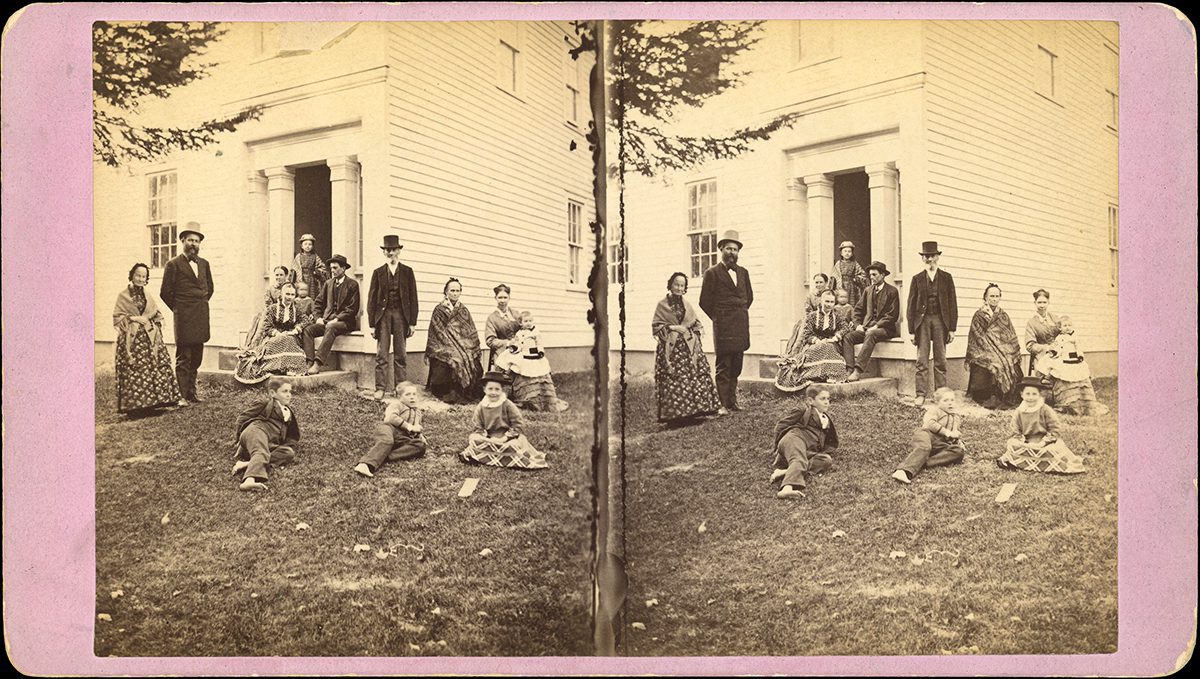
The photograph arranges a large group across the doorway, steps, and lawn of a clapboard house. Some adults stand; others sit near the entrance. Children occupy the foreground. Clothing, postures, and the distances between people are all part of the record. This is a posed photograph, but it is not the isolated bust portrait through which a president is usually remembered.
The figure identified on the reverse as Garfield stands near the left edge of each view, beside the woman the writer identifies as his mother. He does not occupy the centre. The composition gives the house and the gathering as much importance as the future president. That displacement is the photograph’s great strength: it asks us to see a network of relationships, not simply to recognise a famous face.
The complete mount is shown here. Its pale pink front and red-orange reverse are evidence too. The maker’s printed advertisement, later stamps, and handwritten account belong to the history of this particular surviving object; they should not be stripped away to turn it into a generic illustration.
2. The reverse is a second historical document
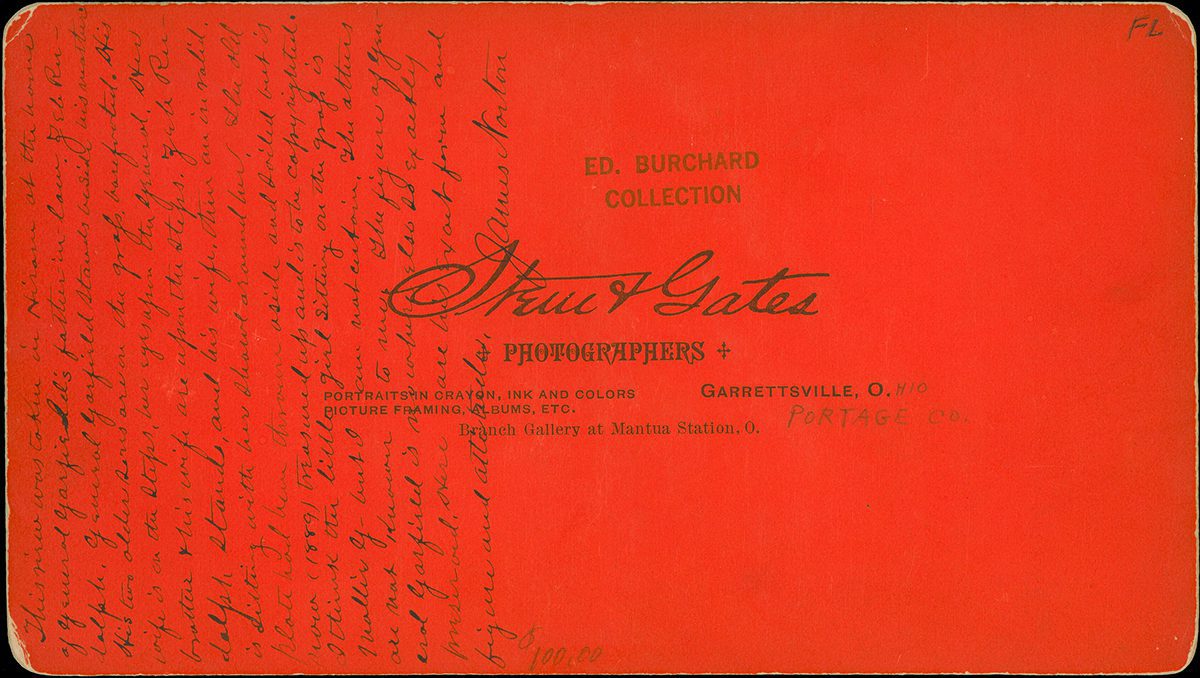
The imprint reads Struve & Gates, Photographers, at Garrettsville, O., with a “Branch Gallery at Mantua Station, O.” It advertises portraits in crayon, ink, and colours, picture framing, albums, and related work. This establishes the business credited on the mount. It does not establish which partner operated the camera, nor whether this print was issued immediately after the negative was made.
A stamp reads “ED. BURCHARD COLLECTION.” That is a collection mark, not a photographer’s credit. Without acquisition or transfer records it cannot supply a complete provenance chain.
The following is a working transcription of the legible portion of the handwritten account. Line breaks are removed; uncertain readings appear in brackets. The difficult closing sentence is omitted rather than reconstructed. This is not a certified verbatim transcription.
“This view was taken in Hiram at the home of General Garfield’s father in law Zeb. Rudolph. General Garfield stands beside his mother. His two elder sons are on the [grass], barefooted. His wife is on the steps, [her eyes upon the General?]. Her brother & his wife are upon the steps. Zeb. Rudolph stands, and his wife, then an invalid, is sitting with her shawl around her. The old [plate] had been thrown aside and [soiled] but is now (1889) treasured up and is to be copyrighted. I think the little girl sitting on the [grass] is Mollie G. but I am not certain. The others are not known to me. […]”
Signature: “James Norton.” The final sentence remains incompletely deciphered. “Plate,” “soiled,” and several connecting words need confirmation from the physical card or a sharper reverse scan.
The inscription in reading orientation
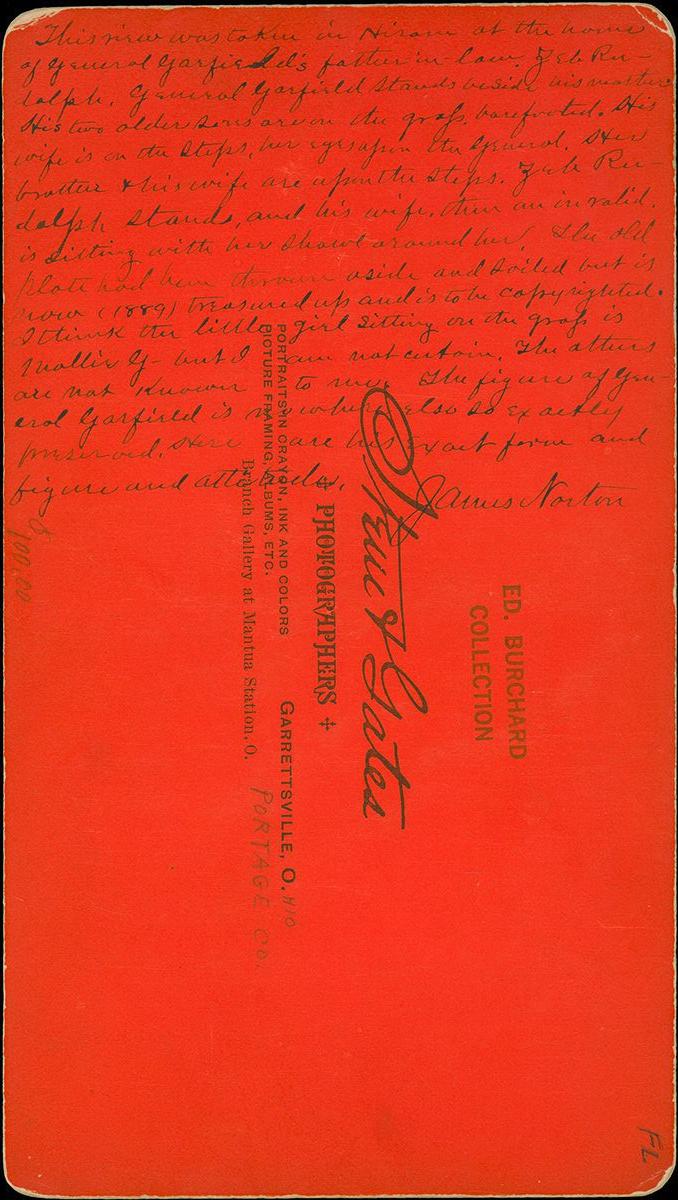
The writer’s own uncertainty matters. He says “I think” about the girl he calls Mollie and explicitly says that other people are unknown to him. A modern caption should preserve that distinction, rather than flatten the whole account into a confident list of names.
3. Names, relationships, and degrees of certainty
- James A. Garfield
- Identified by the writer as the standing man beside his mother. A comparison with securely identified portraits and another copy of this image would strengthen the identification.
- Garfield’s mother
- Named by relationship in the note. The association with Eliza Ballou Garfield is a genealogical interpretation of that wording, not a separate label written on the front.
- Lucretia Garfield
- The note places Garfield’s wife on the steps. The National Park Service independently establishes Lucretia’s identity and her father Zeb Rudolph, but does not, in the sources cited here, identify this particular photograph.
- Zeb Rudolph and his wife
- The writer identifies a standing Zeb and a seated wife wrapped in a shawl. NPS names Lucretia’s parents as Zeb and Arabella Mason Rudolph. The statement that the seated woman was an invalid remains the inscription’s claim.
- Two elder sons
- Identified by relationship only. The note says they are barefooted on the grass. Assigning each boy a name and position requires further corroboration.
- Mollie, possibly
- The writer tentatively identifies the foreground girl as Mollie Garfield and expressly admits uncertainty. The tentative identification stays tentative.
- Lucretia’s brother and his wife; other sitters
- Two people on the steps are identified by relationship but not named. Others are expressly unidentified. No additional names are assigned here.
Lucretia’s family is not incidental background. The NPS biography places her childhood in Garrettsville, among Rudolph and Mason relatives, and describes the importance her parents attached to education. The photographer’s Garrettsville imprint belongs to that same regional world. Geographic proximity is context, not proof of the photographic commission.
4. Hiram is not the campaign porch at Lawnfield
The inscription begins with Hiram. That is an important distinction. Garfield’s best-known domestic site is Lawnfield in Mentor, the setting of his 1880 front-porch presidential campaign. The National Park Service distinguishes that Mentor home, used from 1876 to 1881, from the earlier Hiram home on Hinsdale Street.
The NPS account places Garfield’s education, marriage, and early political career in Hiram. Its Lucretia biography also describes Zeb’s new farmhouse on Hiram Hill, where students and faculty boarded and the Rudolphs’ home became a centre of campus life. Reading this image as a Hiram gathering places it within that formative setting, rather than treating every photograph of a Garfield house as a presidential campaign image.
The note calls the location the home of Garfield’s father-in-law, Zeb Rudolph; the separately catalogued green-mounted version repeats that identification. This is not a licence to substitute the Garfields’ own Hinsdale Street address. The precise building and address still require property history and architectural comparison. Two family homes in one village are not interchangeable.
5. Why this belongs in presidential history
The historical force of this object does not depend on calling it the only surviving example. Its force comes from what it lets us attend to: a future president positioned within a household, sharing a lawn and doorway with children, women, in-laws, and people whose names have not survived in the caption.
Presidential portraiture often converts a life into an emblem: the recognisable face, the office, the campaign, the assassination. This photograph works in the opposite direction. The public figure occupies ordinary space and is not isolated from those around him. The children in the foreground and the seated woman’s shawl carry as much visual weight as his standing figure. That is an interpretation of the photograph’s composition, not a claim that it captures an unguarded moment.
The later account introduces another layer: remembrance. The wording about an old plate being discarded and then treasured, together with the reference to copyright, suggests a change in how the image was valued. A domestic group could be revisited as a relic of a president. The note therefore records not only who the writer believed was pictured, but how a photograph could acquire a different historical meaning after its making.
That tension is worth serious discussion. How much of the image’s importance resides in Garfield’s presence? How much resides in the relationships around him? And what happens when later fame becomes the reason an ordinary household photograph survives?
6. A stereoview brings the viewer to the lawn
The paired photographs offer more than a repeated composition. Stereoscopic photography places two slightly displaced viewpoints before the eyes so that the viewer can perceive depth. Here the space between the foreground children, steps, standing adults, and house is central to the encounter. The subject is not simply a face to recognise; it is a place to look into.
Technical analysis of the new archive scans confirms a genuine stereo pair: the two views differ in the relationship of figures and background edges exactly as two cameras a few inches apart would record them. The view below is fused from those two original photographs — nothing is synthesized or reconstructed.
Nor does three-dimensional viewing guarantee factual certainty. It can make the scene feel immediate while leaving the date, names, commission, and history of the negative unresolved. Presence and proof are different things.
7. What remains to be established
- An institutional comparison: the separately catalogued green-mounted card offers a visual match and a written 1873 date. An institutional record or contemporary documentation is still needed to corroborate its date and identifications. No institutional match has yet been verified; that is not evidence of uniqueness.
- The building: compare this façade with Hiram house photographs and property records, and resolve the note’s father-in-law wording.
- The people: corroborate Norton’s identifications against Garfield family photographs and records; do not fill unnamed positions by resemblance alone.
- The exposure date: combine the verified sitters, the family chronology, the building, and the photographers’ business dates. A narrow range must be earned, not inferred from clothing alone.
- James Norton: establish who wrote the note, his connection to the family or photograph, and how he obtained his information.
- The 1889 copyright reference: locate a registration, correspondence, or publication connecting the remark to this image.
- Object history: document the Ed. Burchard collection mark and subsequent ownership with records, rather than treating a stamp as full provenance.
These open questions do not diminish the photograph. They define the difference between a powerful object and a finished historical argument. The article will be revised when a matched print, primary record, or more legible inscription changes the evidence.
Sources & further reading
- Macrafly archive, MSV1312, front and reverse reproduced above. Primary evidence for the composition, imprint, collection stamp, handwritten identifications, and 1889 reference. Working transcription from the digital reverse; uncertain readings marked.
- National Park Service, “Nearby Attractions,” James A. Garfield National Historic Site. Supports the distinction between Hiram and Mentor, Garfield’s Hiram associations, the 1876–1881 Mentor home, the 1880 campaign, and his death in 1881. Does not authenticate this card’s individual sitters.
- National Park Service, “Lucretia R. Garfield: A Remarkable Life.” Supports Lucretia’s family relationships, her Garrettsville upbringing, and her parents’ names; not a catalogue record for this photograph.
- Hiram College, “The Garfield Trail.” Further reading on the Hiram setting. Direct access was restricted during this review; the historical claims above rely on the accessible NPS accounts instead.
- Haec City / Also Books, “James A. Garfield family stereograph, 1873.” A commercial catalogue, not an institutional authentication. Its green-mounted photograph matches the group visually; its description quotes a reverse identification and 1873 date and reports a copy-negative stamp. The seller’s estimated print date is about 1881, not 1889.
- National Park Service, “Zeb Rudolph” and “Arabella Mason Rudolph.” Independent biographical context for Lucretia’s parents and their Hiram connections; neither is presented as authentication of this specific card.
Research status, October 7, 2026: an initial evidence-led study, not a complete census of surviving prints or a final attribution of every sitter. Rarity, an exact exposure date, and a full provenance chain are not established.